The Divine Healer of Angkor: Understanding Bhaisajyaguru, the Medicine Buddha

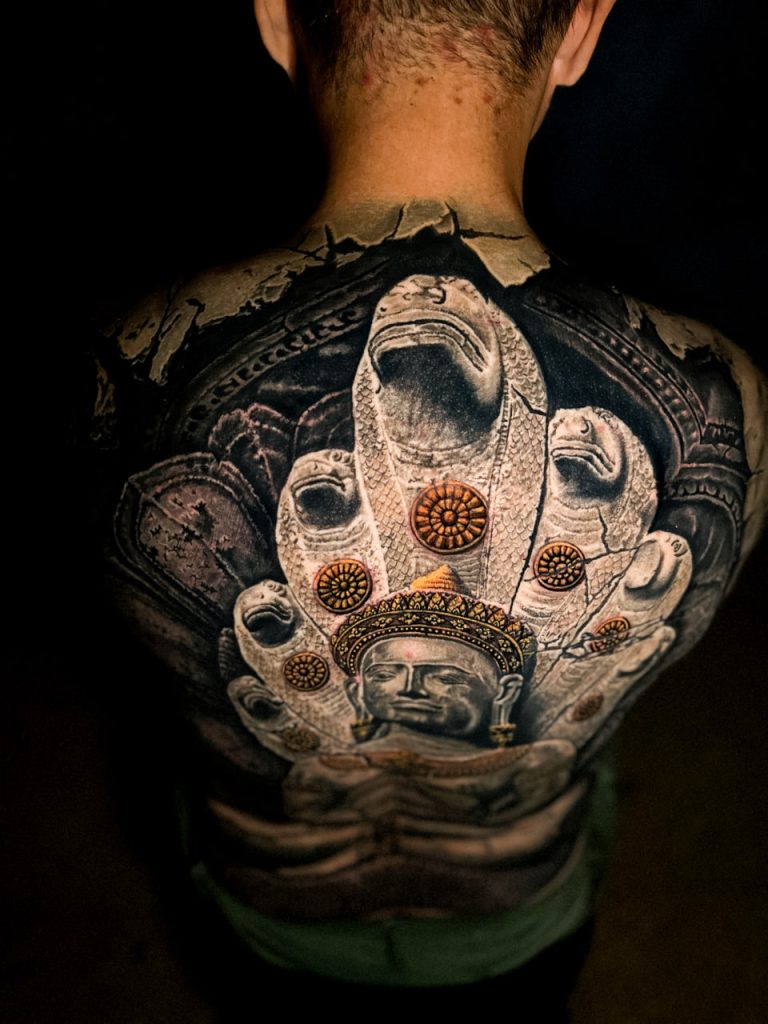
SIEM REAP, CAMBODIA — In the heart of the ancient Khmer Empire, spirituality and science were never far apart. Among the most revered figures from this era is Bhaisajyaguru, known as the “Medicine Buddha” or (Khmer: ព្រះអង្គ ប្រកនាគ) Preah Ang Brok Neak. Today, we explore the profound history and the stunning artistic evolution of this deity, specifically focusing on the Angkorian style characterized by stone textures and exquisite gold-accented jewelry.

Bhaisajyaguru, the Medicine Buddha

The Master of Remedies

The name “Sri Bhaisajyaguru Vaidurya Prabharaja” translates from Sanskrit as the “Master of Remedies and the Lord of Lapis Lazuli Light.” In the Mahayana Buddhist tradition, Bhaisajyaguru is the Buddha of healing and medicine. While he cures physical ailments, his primary mission is spiritual: he treats the ultimate “sickness” of human suffering through the “medicine” of his teachings.

Historically, Bhaisajyaguru is believed to have attained Buddhahood long ago. He reigns over the Eastern Paradise of Abhirati and is often flanked by two Bodhisattvas: Suryavairocana (representing the Sun) and Candravairocana (representing the Moon), who assist him in dispelling the darkness of suffering.

The Guardian of Ancient Hospitals

The legacy of the Medicine Buddha is inseparable from the reign of King Jayavarman VII. During the peak of the Angkorian era, the King commissioned the construction of 102 hospitals (Arogyasala) throughout the empire.

Inscriptions at the iconic Bayon Temple frequently invoke the name of Bhaisajyaguru, cementing his role as the patron deity of these ancient medical centers. To this day, archaeological excavations—such as those at Tonle Snguot Temple—continue to unearth fragments of Bhaisajyaguru statues, proving that these sites served as both places of physical healing and spiritual refuge.

Artistic Mastery: The Angkorian Style

The aesthetic representation of Bhaisajyaguru has evolved into a unique Khmer art form. The modern “Angkor Style” creates a striking contrast between the old and the divine:

  • Stone-Textured Finish: The body of the statue often features a rugged, matte finish that mimics the ancient sandstone of the Angkor temples, grounding the figure in history.

  • Gold Ornamentation: To signify his celestial status, the statue is embellished with intricate gold jewelry—including crowns, necklaces, and armlets—which shine brilliantly against the stone-like texture.

  • The Healing Touch: Devotees have long believed that touching these sacred carvings can transmit healing energy, a tradition that continues to inspire artists and believers alike.

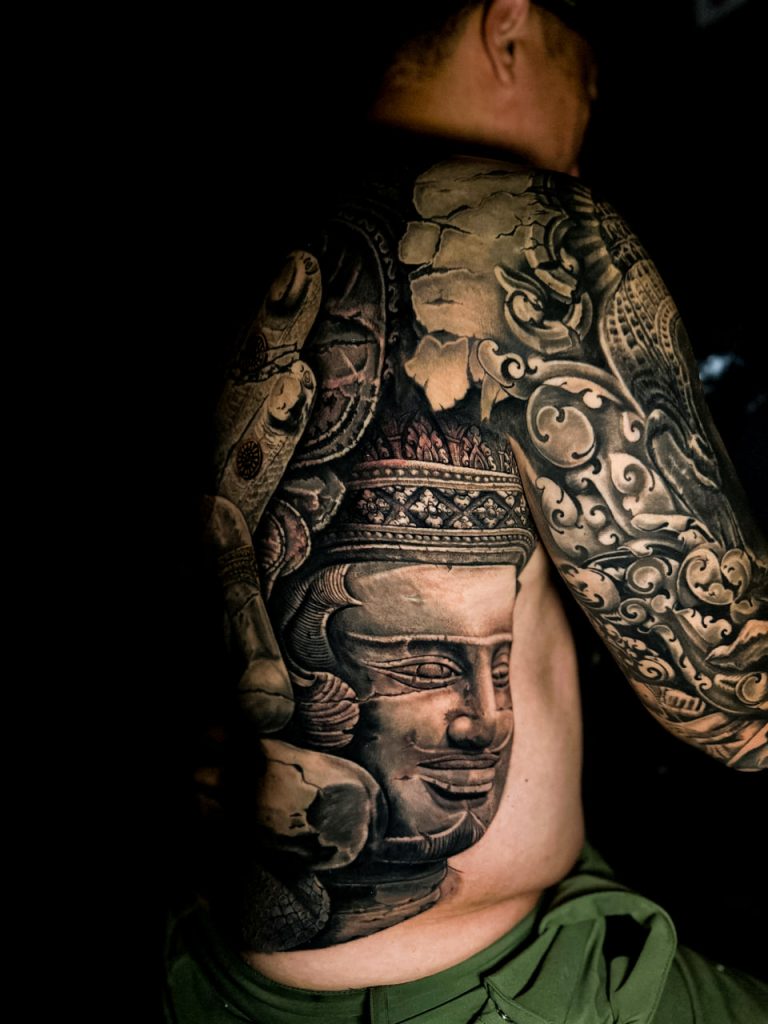
The tattoo on the left is of Lord Brahma.

In the world of spiritual tattoos and traditional Khmer iconography, few figures carry as much weight and cosmic significance as Lord Brahma. Often depicted in intricate detail, a tattoo of Lord Brahma on the left side is more than just a piece of art; it is a tribute to the origin of existence itself.

Who is Lord Brahma?

Lord Brahma is one of the three supreme deities (the Trimurti) in Hinduism and Brahmanism. While he is often considered the second deity in order of functional hierarchy, he serves as the foundational root of the faith. He is the Great Creator, the architect of the four Vedas, and the source of all natural laws.

According to ancient Khmer scriptures and traditional records, Brahma’s influence extends over all elements of the universe:

  • The Five Elements: Water, Earth, Fire, and Air.

  • Life Forms: Plants, animals, and humanity.

The Legend of the Golden Egg

Khmer tradition offers a fascinating perspective on the birth of the universe. It is recorded that Lord Brahma emerged from a thousand-petaled lotus growing from the navel of Lord Vishnu.

Upon his manifestation, Brahma created the Earth through a divine Golden Egg. This egg floated in the vacuum of the universe for ten thousand Kalpas—a staggering span of time equivalent to approximately $4.54 \times 10^9$ years (over 4 billion years).

The creation process was a masterclass in cosmic balance:

  1. The Upper Half: Flew upward to form the heavens and the sky.

  2. The Lower Half: Settled below to form the solid earth.

  3. The Union: The gravitational pull between these two halves solidified the world as we know it today.

The Evolution of Humanity

In the early ages of the Earth, the world was inhabited only by nature and animals. Over hundreds of thousands of years, two distinct beings emerged: the Yaksha (Giants) and the Vanara (Monkeys), who engaged in eternal conflict.

Eventually, the evolution of the Vanara led to the birth of the human race. The first humans were divided into two genders: the male, known as Buma, and the female, known as Virajja. Through their union, the human race multiplied and flourished, populating the world under the watchful eye of the Creator.

“Bhaisajyaguru is more than a statue; he is a symbol of the Khmer commitment to compassion and public welfare that dates back over eight centuries.”